Why is theright-hand surf break of Figueira da Foz ideal for surfing?
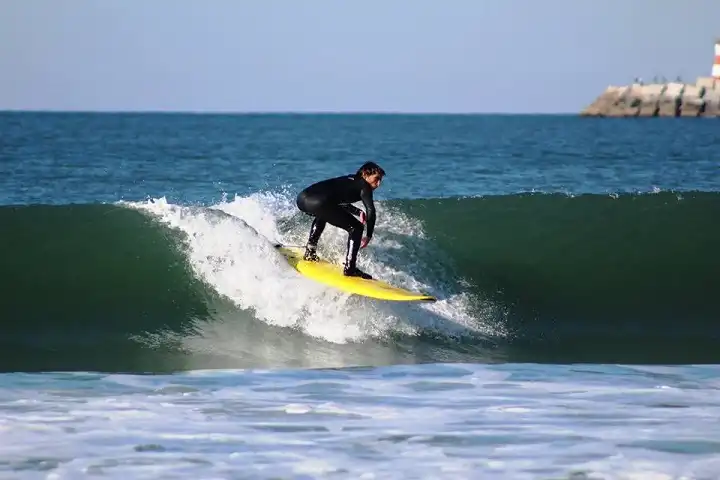
The right-hand wave at Figueira da Foz is a natural phenomenon that attracts experienced surfers from Portugal and abroad.
The wave that forms off Cabedelo beach has become known as one of the longest right-hand waves in Europe.
With fast sections, tubes, and maneuverable walls, it is sought after by those who want to test their technical level and ability to read the waves. Understand how it forms and what this means for surf enthusiasts.
Right wave of Figueira da Foz: how is it formed?
Right wave of Figueira da Foz: how is it formed?
Few areas in central Portugal are as conducive to surfing as Figueira da Foz.
Part of this reputation is due to the famous right-hand wave of Figueira da Foz, a type of wave that frequently forms in this region.
Let’s look at the reasons for this phenomenon.
A constantly transforming sandbar
The formation of the right-hand wave at Figueira da Foz depends on a delicate balance between natural conditions and human actions.
The central point is the sandbar that accumulates next to the north breakwater of the Mondego River estuary.
This sandbar is not fixed: it is sculpted by the currents, the river flow, and the prevailing swell.
During the autumn and winter months, Atlantic storms bring northwest swells with a long period (over 12 seconds), which enter the Figueira bay with force.
Upon encountering the well-aligned sandbar, these swells create waves that break to the right, with clean and prolonged formation.
The north breakwater plays a decisive role. It acts as a filter, blocking some of the wave energy and guiding the swell.
The orientation of the coast and protection from northerly winds also favor wave quality, keeping the water surface more regular, especially on offshore mornings.
Why is this type of wave advantageous?
Why is this type of wave advantageous?
The length of the wave is one of its biggest attractions.
On consistent days, it’s possible to surf more than 200 meters without leaving the face of the wave, with sections alternating between fast tubes and more open areas, ideal for maneuvers. This continuity allows for more intense training in fluidity, positioning, and line reading than in short beach breaks.
The right-hand break at Figueira da Foz is also one of the few waves in Portugal that offers potential for technical filming and high-performance training.
Its predictability, especially when the sandbar is formed, allows for sessions with various types of boards and surfing styles.
Furthermore, direct access to the wave from the sandbar at Cabedelo facilitates entry and exit from the sea, even on days with strong waves.
The relatively constant depth of the breaking zone contributes to a progressive takeoff, allowing for smooth adjustments and transitions right at the beginning of the wave face.
Conclusion
Conclusion
The right-hand wave at Figueira da Foz surf break is more than just another wave on the Portuguese coast.
It’s the result of a unique geographical configuration, shaped by the interaction between the Mondego River, the north pier, and the shifting sandbanks.
When everything aligns, it provides memorable sessions, capable of marking the progression of any surfer.
Whether for barrels, cutbacks, or simply feeling the natural speed of the line, this right-hand wave remains a benchmark in European surfing.
And to get the most out of not only the right-hand wave, but other types of waves as well, count on Surfing Figueira to develop your full surfing potential.
Book your online lesson and come experience it with us.